Vincent van Gogh is one of the most celebrated artists in history, known for his bold colors, expressive brushwork, and emotionally powerful paintings. Although he struggled during his lifetime, his works are now among the most famous and valuable in the world.
Van Gogh created around 900 paintings, many of which are now considered masterpieces of modern art.
In this article, we explore Van Gogh’s most famous paintings, their stories, and what makes them so important.
1. The Starry Night (1889)
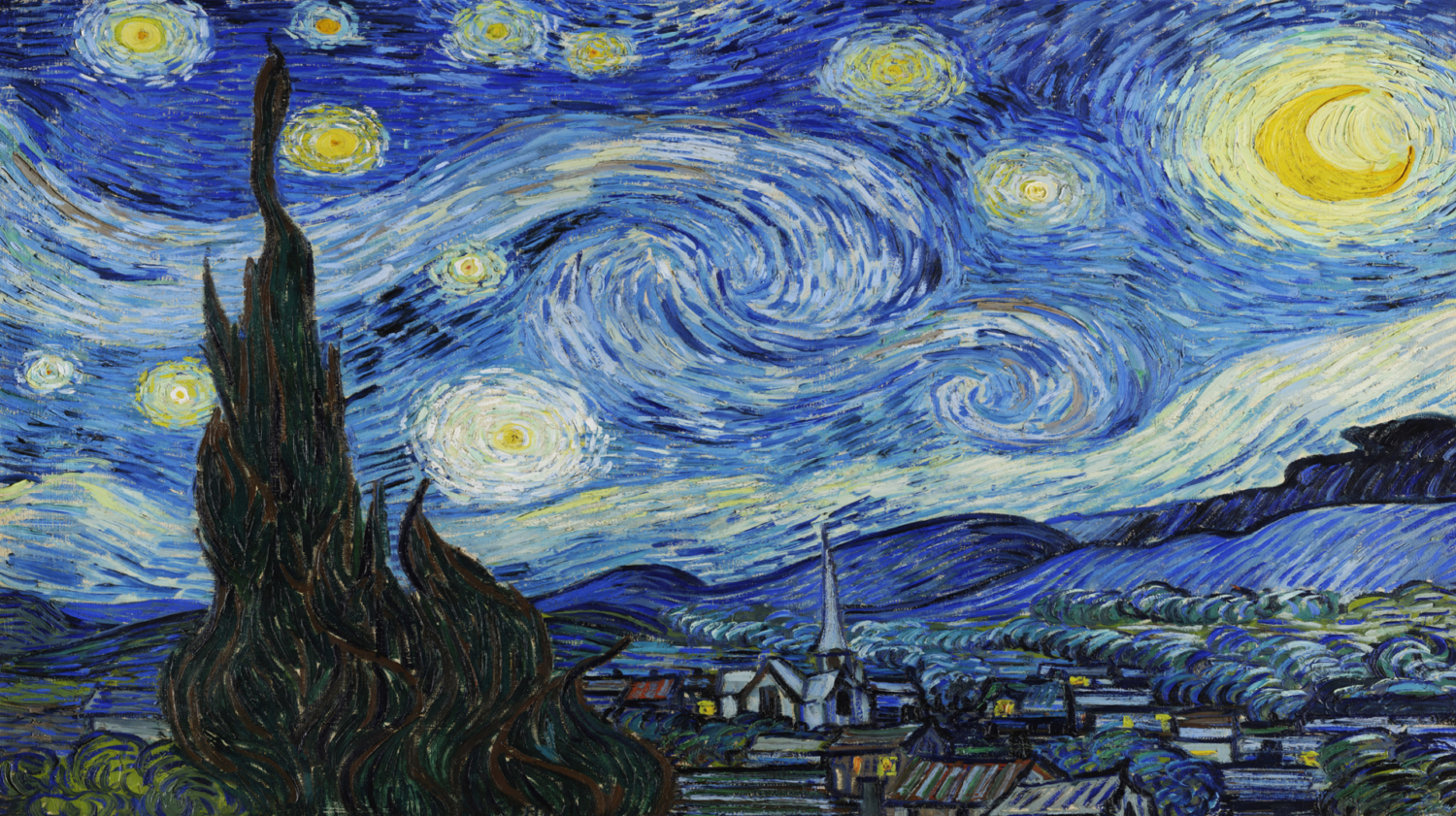
Perhaps the most famous painting Van Gogh ever created, The Starry Night was painted in June 1889 while he was staying at the Saint-Paul-de-Mausole asylum in Saint-Rémy-de-Provence, France. The painting depicts a swirling night sky filled with glowing stars and a luminous crescent moon above a quiet village, with a dramatic cypress tree rising in the foreground.
What makes it extraordinary is how Van Gogh combined observation with imagination — the village was invented, the sky painted largely from memory, yet the result feels more emotionally true than any realistic depiction could. The thick, curving brushstrokes give the sky a sense of cosmic energy that art historians have noted bears a remarkable resemblance to the mathematical patterns of turbulent fluid dynamics.
Today it hangs at the Museum of Modern Art (MoMA) in New York City and is one of the most visited artworks in the world.
👉 Read the full guide to The Starry Night
2. Sunflowers (1888–1889)
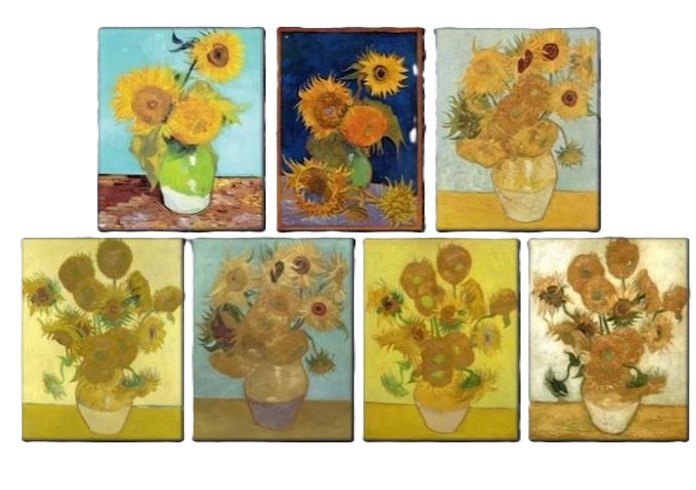
Van Gogh’s Sunflowers series is among the most recognizable still-life paintings ever made. He created two groups — the first in Paris in 1887, and the more famous second group in Arles in 1888–1889, where he depicted sunflowers arranged in a vase using an almost entirely yellow palette ranging from lemon to amber to ochre.
The paintings were originally created to decorate his Yellow House in Arles and welcome fellow artist Paul Gauguin. For Van Gogh, sunflowers represented friendship, warmth, and gratitude. His use of impasto — thick, raised paint applied directly from the tube — gives the flowers a sculptural, almost three-dimensional presence on the canvas.
Different versions of the Sunflowers are now held at the National Gallery in London, the Van Gogh Museum in Amsterdam, the Neue Pinakothek in Munich, and the Sompo Museum of Art in Tokyo.
👉 Read the full story behind Sunflowers
3. Café Terrace at Night (1888)

Painted in September 1888 in Arles, Café Terrace at Night depicts a lively outdoor café illuminated by warm yellow gaslight under a deep blue, star-filled sky. Van Gogh set up his easel directly on the street at night — an unusual practice at the time — to capture the atmosphere of the scene in real conditions.
One of the painting’s most innovative features is that Van Gogh painted the entire night scene without using a single drop of black paint. Instead he represented darkness through deep blues, violets, and greens, creating a night that feels vibrant and alive rather than flat. This approach directly influenced his later night paintings, including The Starry Night.
The café in the painting still exists in Arles today, now called Café Van Gogh, repainted in yellow to match the painting. The original work is held at the Kröller-Müller Museum in Otterlo, Netherlands.
👉 Read the full story behind Café Terrace at Night
4. Irises (1889)
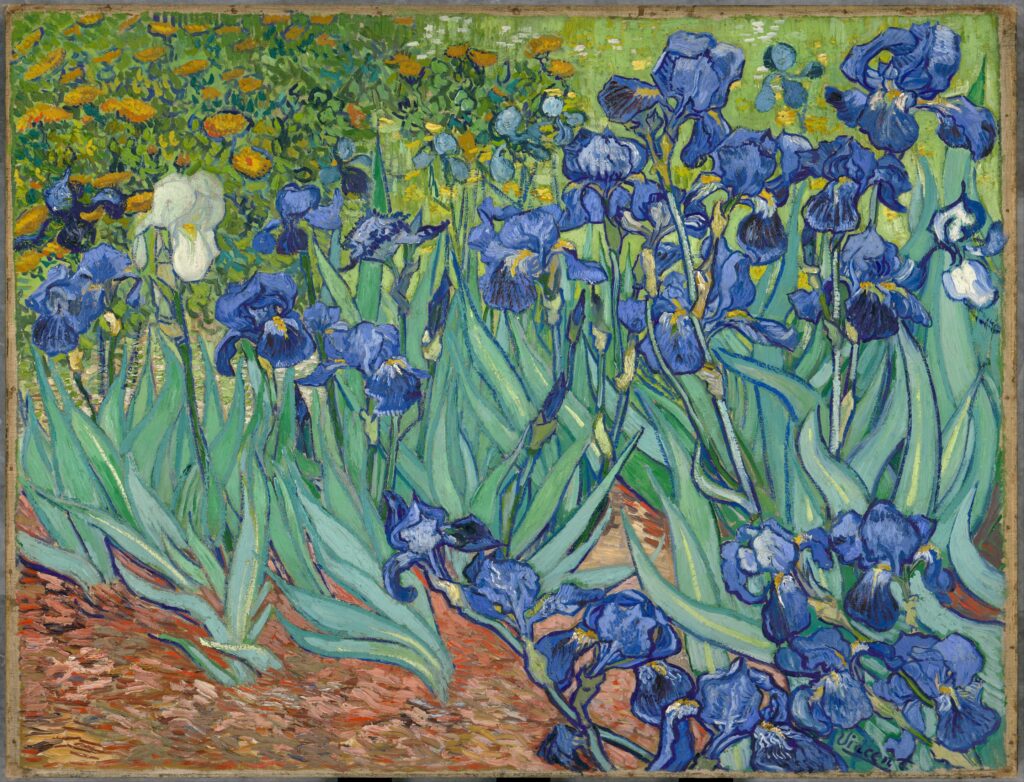
Irises was one of the first paintings Van Gogh completed after entering the Saint-Paul-de-Mausole asylum in Saint-Rémy in May 1889. He painted the flowers growing naturally in the asylum’s garden, depicting their curved leaves and vivid blue petals with bold outlines and strong color contrasts that show his deep admiration for Japanese woodblock prints.
The painting is notable for a single white iris standing out among the blue flowers — often interpreted as a symbol of individuality or quiet isolation. For Van Gogh, painting the garden was also a form of therapy: nature gave him focus and calm during one of the most turbulent periods of his life.
In 1987 the painting sold at auction for a then world-record price. It is now housed at the J. Paul Getty Museum in Los Angeles.
👉 Read the full story behind Irises
5. The Bedroom (1888)
The Bedroom depicts Van Gogh’s simple room inside the Yellow House in Arles. He painted three versions of this composition — in 1888, and twice in 1889 — and considered it one of his most personal works. He wrote to his brother Theo that he wanted the painting to express absolute rest through its colors and simplified forms, removing shadows entirely and flattening the perspective.
The bold, flat colors and slightly tilted floor give the room a slightly dreamlike quality that was deliberate rather than accidental — Van Gogh was experimenting with using color and composition to convey feeling rather than visual accuracy. The painting offers a rare glimpse into the private, modest life of one of history’s greatest artists. The three versions are held at the Van Gogh Museum in Amsterdam, the Art Institute of Chicago, and the Musée d’Orsay in Paris.
6. Wheatfield with Crows (1890)
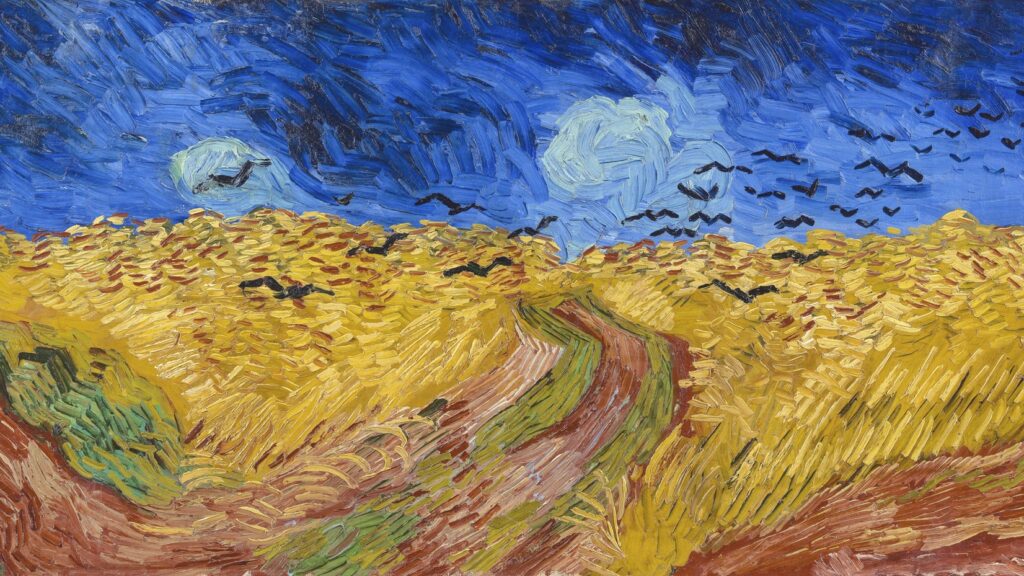
Wheatfield with Crows is one of the last paintings Van Gogh completed before his death in July 1890. Painted in Auvers-sur-Oise, it depicts a vast golden wheat field under a turbulent, stormy blue-green sky, with a flock of black crows rising from the grain. Three paths lead into the field from the foreground but none of them lead anywhere — they simply disappear into the wheat.
The painting has long been associated with Van Gogh’s state of mind in his final weeks, and its atmosphere of foreboding and emotional intensity makes it one of the most powerful images in his entire body of work. Whether or not it was intended as a farewell, it reads like one. The painting is held at the Van Gogh Museum in Amsterdam.
7. The Night Café (1888)
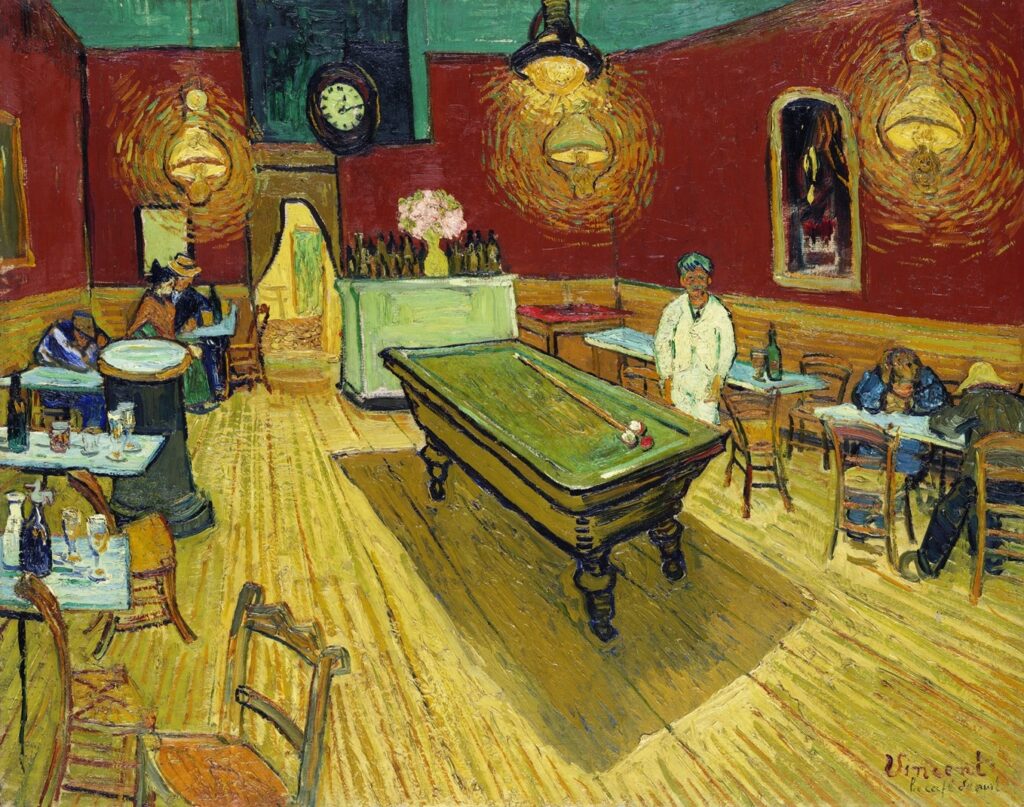
The Night Café was painted in September 1888, just weeks before Café Terrace at Night, and represents a very different vision of night life. Where the terrace scene feels warm and inviting, The Night Café is deliberately unsettling — Van Gogh described it in a letter as a place where “one can ruin oneself, run mad, or commit a crime.”
The interior is bathed in clashing reds and greens that he used specifically to convey tension and unease. A lone billiard table sits under a harsh gas lamp, while a few isolated figures slump at tables around the edges of the room. Van Gogh used distorted perspective and violent color contrasts to express something he couldn’t say in words. The painting is held at the Yale University Art Gallery in New Haven, Connecticut.
Why Van Gogh’s Paintings Are So Famous
Van Gogh’s paintings stand out because of:
- Bold and expressive brushwork
- Vibrant and emotional use of color
- Unique artistic vision
- Powerful personal story
His work played a key role in shaping modern art and continues to influence artists today.
Conclusion
Vincent van Gogh’s paintings remain some of the most recognizable and admired artworks in the world. From The Starry Night to Sunflowers and Irises, his masterpieces continue to inspire millions of people.
Although he received little recognition during his lifetime, Van Gogh is now considered one of the greatest artists in history.
A: The Starry Night, painted in June 1889, is widely considered Van Gogh’s most famous painting. It depicts a swirling night sky above a quiet village and is housed at the Museum of Modern Art (MoMA) in New York City. It is one of the most visited and reproduced artworks in the world.
A: Van Gogh produced approximately 900 oil paintings and over 1,100 drawings and sketches during his career. Almost all of them were created in the final ten years of his life, between 1880 and his death in 1890.
A: Van Gogh’s paintings are held in major museums around the world. The Van Gogh Museum in Amsterdam has the largest collection. Other key institutions include the Museum of Modern Art in New York (The Starry Night), the National Gallery in London (Sunflowers), the Kröller-Müller Museum in the Netherlands (Café Terrace at Night), and the J. Paul Getty Museum in Los Angeles (Irises).
A: Van Gogh’s Portrait of Dr. Gachet sold in 1990 for $82.5 million ($205 million in today’s value), making it one of the most expensive paintings ever sold at that time. Several other works including Irises and Portrait of Joseph Roulin have also sold for record-breaking prices at auction.