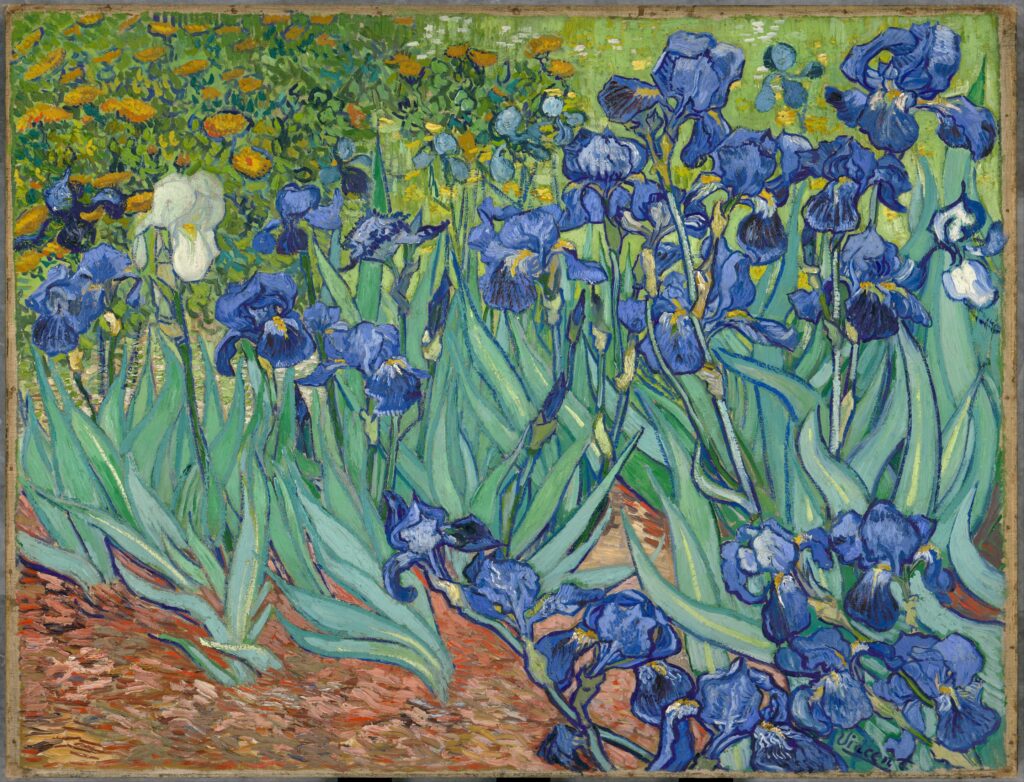
Irises is one of the most celebrated paintings by Vincent van Gogh. Painted in 1889, the artwork features vibrant blue irises growing in a garden, captured with bold brushstrokes and striking colors.
The painting is admired for its harmony of color, energetic lines, and natural beauty. Today, Irises is considered one of Van Gogh’s greatest floral paintings and a masterpiece of the Post-Impressionist movement.
In this article, we explore the story behind Irises, its artistic style, and why the painting remains so famous today.
When Did Van Gogh Paint Irises?
Vincent van Gogh painted Irises in 1889 while staying at the Saint-Paul-de-Mausole asylum in Saint-Rémy-de-Provence, France.
After experiencing several mental health crises, Van Gogh voluntarily entered the asylum in order to recover and continue his artistic work. Despite his struggles, this period became one of the most productive phases of his career.
During his stay, Van Gogh painted the gardens surrounding the asylum, which inspired several of his works. Irises was one of the first paintings he completed there.
The Scene Depicted in the Painting
The painting shows a cluster of blooming blue irises growing in a garden bed. Their long, curved leaves create rhythmic lines that move across the canvas.
Among the blue flowers, one white iris stands out clearly. This subtle difference creates visual contrast and draws attention within the composition.
The background is filled with earthy tones that highlight the bright colors of the flowers and leaves.
Unlike traditional floral paintings arranged in vases, Van Gogh depicted the irises growing naturally in the garden, giving the painting a lively and organic feeling.
Van Gogh’s Use of Color
Color plays a major role in the impact of Irises.
Van Gogh used strong contrasts between:
- Deep blue and violet petals
- Bright green leaves
- Warm orange and brown soil
These contrasting colors make the flowers appear vivid and dynamic. Van Gogh was particularly interested in how complementary colors could enhance each other when placed side by side.
This bold use of color became one of the defining features of his artistic style.
Learn more about Van Gogh’s painting style.
Japanese Art Influence
Van Gogh was deeply inspired by Japanese woodblock prints, which he admired for their simple compositions and strong outlines.
The influence of Japanese art can be seen in Irises. The painting features:
- Clear outlines around the flowers
- Flat areas of color
- A decorative, patterned composition
Instead of using traditional perspective and shading, Van Gogh emphasized the shapes and movement of the plants.
This approach gives the painting a rhythmic and almost decorative quality.
The Meaning Behind Irises
Unlike some of Van Gogh’s more symbolic works, Irises is often interpreted as a celebration of nature and beauty.
The painting reflects Van Gogh’s deep connection to the natural world. Painting flowers and gardens helped him find calm and focus during difficult periods of his life.
The presence of the single white iris among the blue flowers has sometimes been interpreted as a symbol of individuality or isolation, though Van Gogh himself never explained a specific meaning.
Where Irises Is Today
Today, Irises is housed at the J. Paul Getty Museum in Los Angeles.
The painting gained additional fame in 1987 when it was sold for a record-breaking price at auction, making it one of the most expensive paintings ever sold at that time.
Its popularity continues to grow as visitors from around the world come to admire the work.
Why Irises Is So Famous
Irises is considered one of Van Gogh’s greatest floral paintings for several reasons:
- Its vibrant and harmonious color palette
- The energetic movement created by the leaves and petals
- Its connection to an important period in Van Gogh’s life
- Its influence from Japanese art
The painting shows Van Gogh’s ability to transform a simple subject into a powerful and expressive work of art.
Conclusion
Irises stands as one of Vincent van Gogh’s most beautiful and expressive paintings. Created during a challenging period of his life, the artwork demonstrates his remarkable ability to find inspiration in nature.
Through bold color, rhythmic composition, and expressive brushwork, Van Gogh turned a garden of flowers into a masterpiece that continues to inspire audiences around the world.
Today, Irises remains a symbol of Van Gogh’s artistic brilliance and his deep appreciation for the beauty of the natural world.
A: Van Gogh painted Irises in May 1889, shortly after voluntarily admitting himself to the Saint-Paul-de-Mausole asylum in Saint-Rémy-de-Provence, France. It was one of the first paintings he completed there, created in the gardens surrounding the asylum.
A: Irises is housed at the J. Paul Getty Museum in Los Angeles. The painting gained international attention in 1987 when it sold at auction for a then-record-breaking price, making it one of the most expensive paintings ever sold at that time.
A: Among the vivid blue irises, one white iris stands out clearly. Some art historians interpret this as a symbol of individuality or isolation — a single figure standing apart from the crowd — which may reflect Van Gogh’s own sense of being different or alone. Van Gogh himself never explained a specific meaning, so the interpretation remains open.
A: Van Gogh was a great admirer of Japanese woodblock prints and their influence is clearly visible in Irises. He adopted their approach of strong outlines around shapes, flat areas of color, and decorative patterned compositions. Rather than using traditional Western perspective and shading, he emphasized the rhythm and movement of the plants – giving the painting an almost ornamental quality.
A: Irises is celebrated for its vibrant and harmonious color palette, the energetic movement created by the curved leaves and petals, and its connection to one of the most emotionally intense periods of Van Gogh’s life. Painted while he was recovering in an asylum, it shows his extraordinary ability to find beauty and creative focus even during personal crisis.