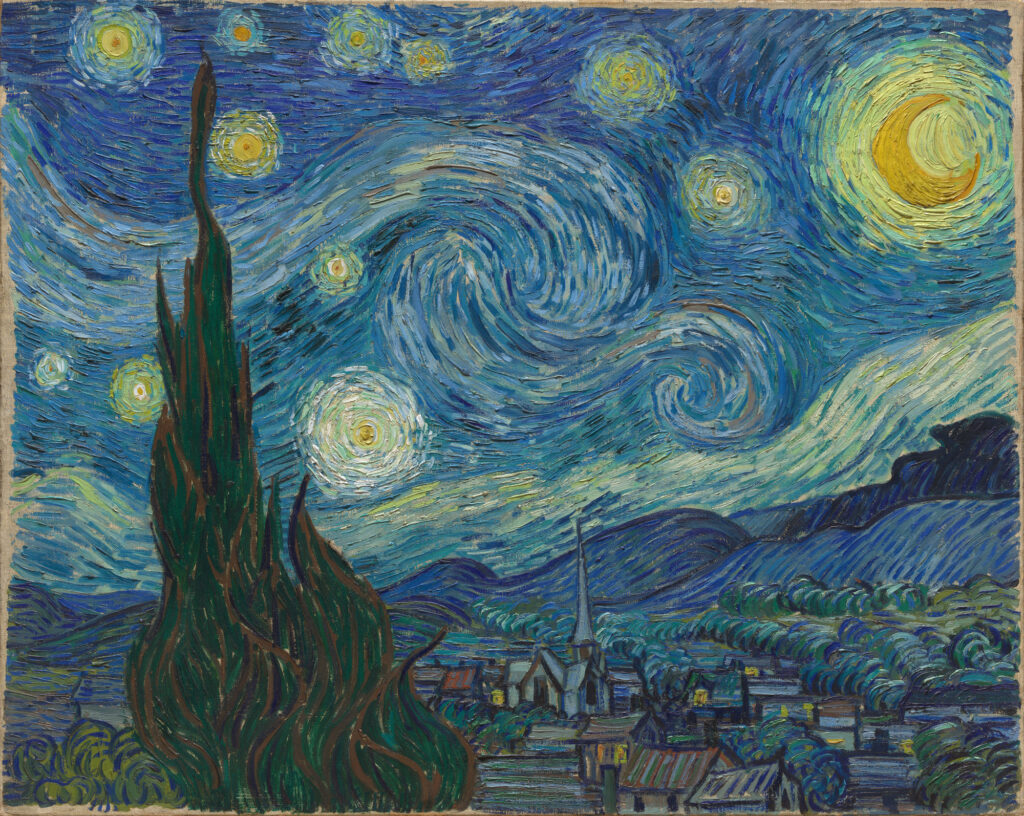
Van Gogh’s The Starry Night (1889) depicts the view from his asylum window in Saint-Rémy-de-Provence, but its meaning lies in what he added from memory and imagination. The swirling sky represents emotional turbulence, the bright morning star (Venus) symbolizes hope, the tall cypress tree connects life and death, and the quiet village offers an anchor of human peace beneath a restless cosmos.
This article walks through every major symbol in the painting, what each one likely represents, and what Van Gogh himself wrote about the night sky that helps decode his masterpiece.
Painted From Memory, Not Just Observation
Van Gogh painted The Starry Night in June 1889 from his second-floor room at the Saint-Paul-de-Mausole asylum, where he had voluntarily committed himself a month earlier following a severe mental health crisis. The rolling hills and the bright morning star match the real view from his window. But almost everything else is invented.
The village beneath the sky was not visible from his room. The church steeple is sharper and more vertical than steeples typical of southern France — it resembles instead the Dutch Reformed churches of Van Gogh’s childhood in the Netherlands. The swirling, looping sky bears no relation to any sky a human eye has ever seen.
This blend of observation and imagination is the key to understanding what the painting actually means. It is not a landscape. It is a vision.
The Emotional Meaning: A Sky in Turmoil
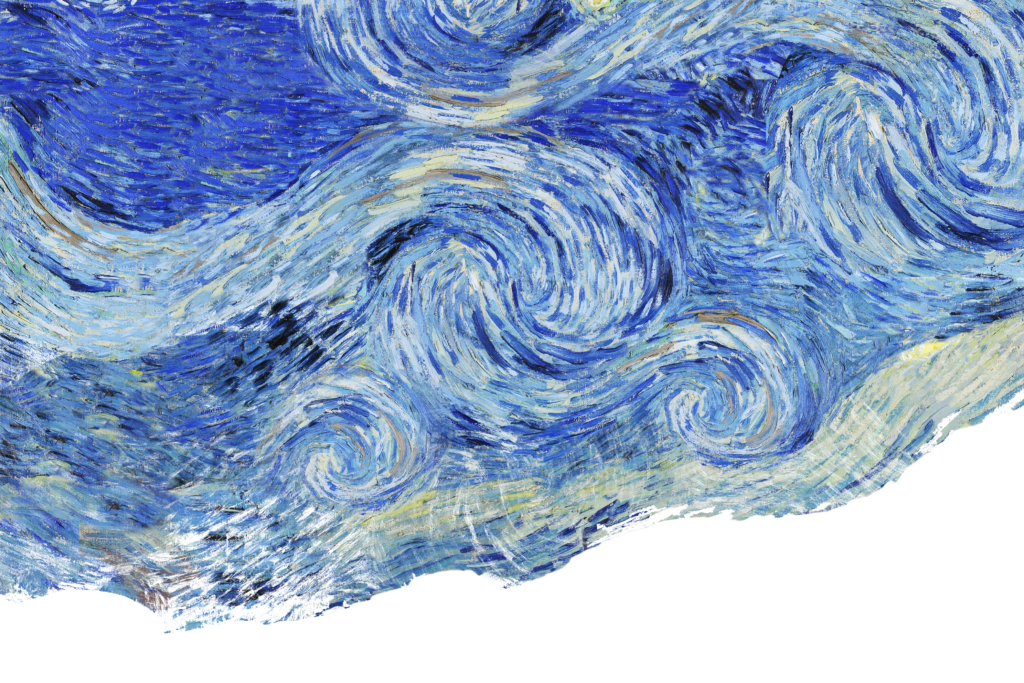
The most discussed element of the painting is the sky itself. The thick, swirling brushstrokes that loop and curl through the upper two-thirds of the canvas are widely read as a visual expression of Van Gogh’s inner emotional state. He had recently suffered the breakdown that led to the famous severing of part of his ear, and he was painting through cycles of recovery and relapse.
But The Starry Night is not a painting of despair. The sky is full of light. The stars glow with concentric halos. The crescent moon throws warm yellow into the cool blues. The contrast between the agitated movement and the radiant light suggests something more nuanced than mental anguish alone — the experience of finding beauty and order inside a chaotic mind.
What Does the Bright Star Represent? (It’s Venus)
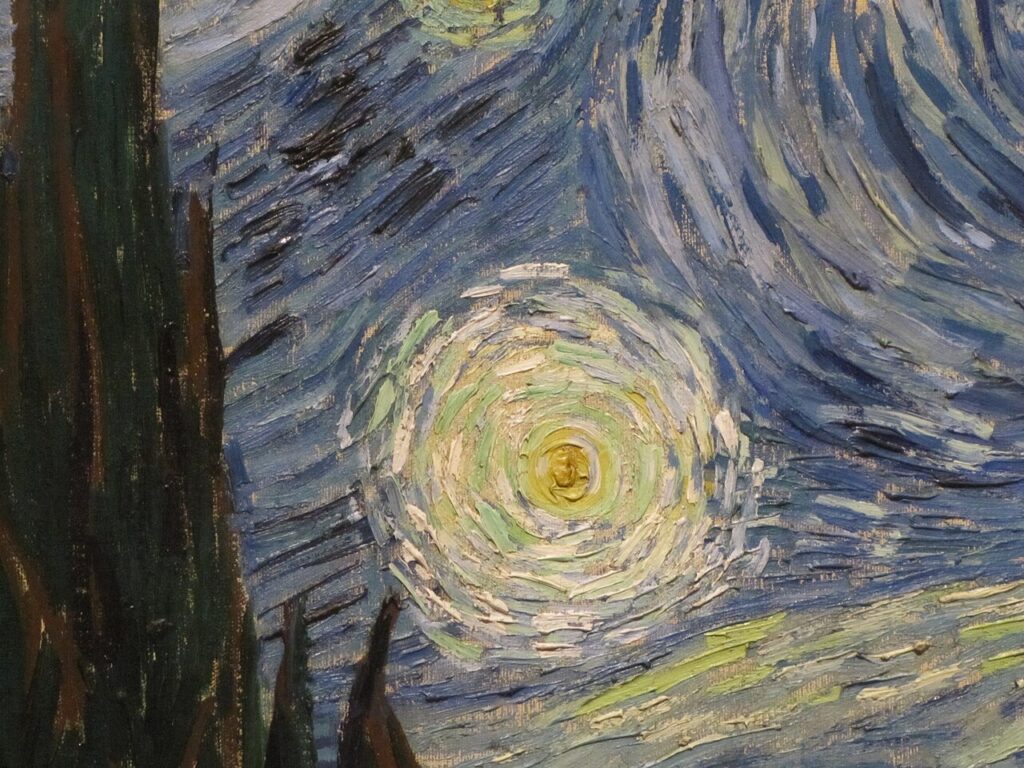
The largest and brightest “star” in the painting, glowing just to the right of the cypress tree, is not a star at all. It is the planet Venus, the morning star. Astronomical reconstructions of the night sky over Saint-Rémy in June 1889 confirm that Venus was visible at that exact position before dawn. Van Gogh painted it deliberately and at scale.
In Western symbolism, the morning star has long represented hope, guidance, and the promise of a new day. For Van Gogh, who wrote often to his brother Theo about the night sky, the morning star was a reminder that even the deepest night ends. It is the painting’s quietest message of optimism.
What Does the Cypress Tree Symbolize?
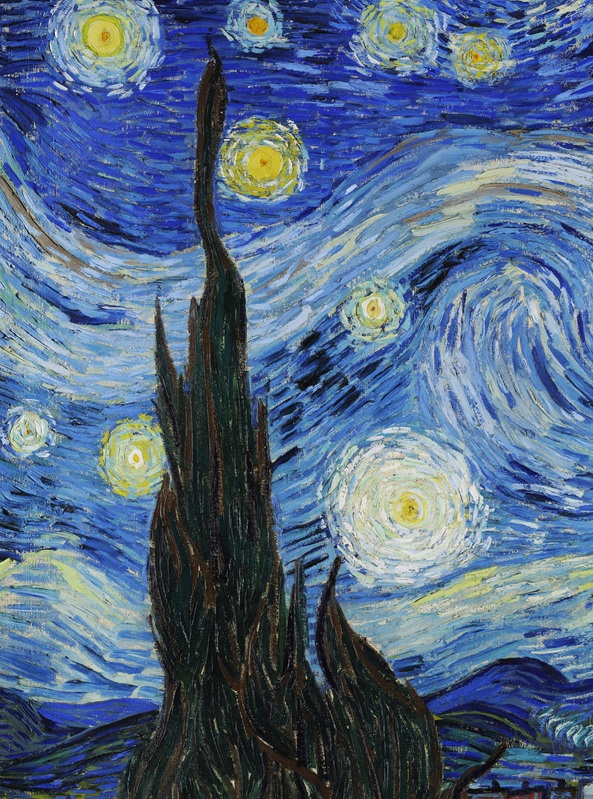
The tall, dark cypress tree in the foreground is the painting’s most loaded symbol. Cypress trees grow throughout the Mediterranean and were traditionally planted in cemeteries — Van Gogh would have seen them daily on his walks around the asylum grounds. In European tradition, the cypress is the tree of mourning, the tree of the dead, the tree of eternal life.
By placing the cypress as a vertical bridge between the village (the earthly world) and the swirling sky (the cosmos, the infinite, the beyond), Van Gogh creates a powerful symbol: the cypress is the connection between life and death, between the human and the divine. It is no accident that it dominates the left side of the canvas, drawing the eye upward and pulling earth into sky.
Why Is the Village So Quiet? Why Is the Church Dark?
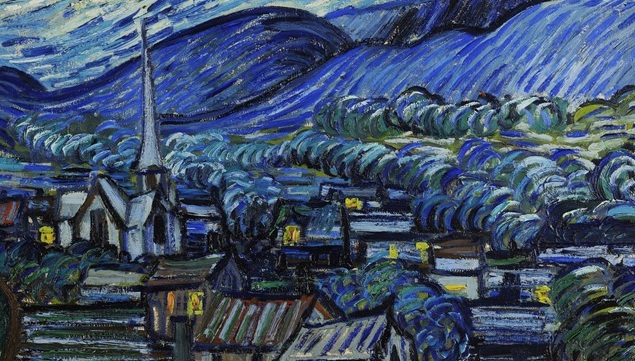
Beneath the violent sky, the village is almost unnaturally still. No figures walk its streets. No lamps glow in its windows. Even the church — the building Van Gogh placed at the center of the village — is dark, with no light coming from its windows.
This is one of the painting’s quietest puzzles. Van Gogh had once trained as a missionary and came from a family of pastors. The dark church may reflect his complicated relationship with organized religion: he had broken with the institutional church years earlier but never abandoned spiritual feeling. Some scholars read the dark church as a sign that, for Van Gogh, divinity had moved out of the building and into the sky.
The Dutch-style steeple is the other clue. Van Gogh was not painting a Provençal church. He was painting a memory of home into a Provençal landscape — Holland’s faith superimposed on France’s hills.
Van Gogh’s Own Words About the Night Sky
The single most quoted statement Van Gogh ever made about stars comes from a letter to his brother Theo in July 1888, the year before he painted The Starry Night:
“Looking at the stars always makes me dream… Why, I ask myself, should the shining dots of the sky not be as accessible as the black dots on the map of France? Just as we take the train to get to Tarascon or Rouen, we take death to reach a star.”
This is the closest thing we have to a written key to the painting. For Van Gogh, stars were not just light — they were destinations. Death, in his framing, was a journey, not an end. Reading The Starry Night through this letter transforms the painting: the swirling sky becomes a vision of where the soul travels, the cypress becomes the vehicle, the morning star becomes the destination.
A Symbol of Hope Inside Darkness
This is why, despite being painted in an asylum by a man in profound distress, The Starry Night is widely read as a painting of hope. The composition itself argues for it. The brightest, warmest passages are at the top of the canvas. The bottom is dark and quiet. Light rises. The eye is drawn upward, past the village, past the cypress, into the radiant sky.
The painting refuses to be a portrait of despair. Whatever Van Gogh’s state of mind in June 1889, his hand chose light.
The Relationship Between Earth and Cosmos
A recurring theme in art-historical readings of The Starry Night is the dialogue between the human world and the universe. The village sits flat and orderly along the bottom of the canvas. The sky above it is anything but orderly — it swirls, it surges, it breaks the laws of physics. Between them stands the cypress, the only object that touches both.
This vertical reading is intentional. The painting argues that human life is small and fragile, but is held inside something vast and luminous. Whether that vastness is read as God, as nature, as the unconscious, or simply as the universe depends on the viewer. Van Gogh left the question open.
Spiritual and Religious Interpretations
Many viewers and scholars have read The Starry Night as a religious painting in disguise. The arguments include:
- The cypress as the traditional tree of mourning, gesturing toward the afterlife
- The eleven visible stars, sometimes linked to the biblical dream of Joseph (Genesis 37:9), in which eleven stars bow before him
- The luminous, halo-ringed celestial bodies that recall medieval depictions of heaven
- The central church beneath an active, living sky, suggesting that the divine has moved outside its walls
Van Gogh never confirmed a religious reading of the painting. But he had been deeply religious in his twenties, and the visual vocabulary of his faith never fully left his work.
Why the Meaning of Starry Night Is Still Debated
There is no single, agreed-upon meaning of The Starry Night, and that is part of why it endures. Van Gogh never wrote an explanation of the finished painting. He died less than thirteen months after completing it, on July 29, 1890. Everything art historians have built since is interpretation, drawing on his letters, his other paintings, and the symbols he chose to include.
The debate continues because the painting works on multiple levels at once: emotional, spiritual, biographical, astronomical, art-historical. Each viewer brings their own reading. That openness is its power.
Starry Night Symbols at a Glance
| Element | What It Likely Represents |
| Swirling sky | Emotional turbulence; the energy of the cosmos |
| Morning star (Venus) | Hope, guidance, new beginnings |
| Crescent moon | Light within darkness; the cyclical nature of time |
| Eleven stars | Possibly biblical (Joseph’s dream); eternity |
| Cypress tree | Death, mourning, the bridge between earth and heaven |
| Quiet village | Human life; peace; stability |
| Dark church | Van Gogh’s complicated relationship with organized religion |
| Dutch steeple | Memory of home; the artist’s Dutch childhood |
Conclusion: What Van Gogh Was Really Painting
The Starry Night is not a picture of a place. It is a picture of an idea — that even in mental anguish, even from an asylum window, even on the edge of death, the world is full of light. Every symbol in the painting carries weight: the cypress reaching toward the sky, the morning star promising dawn, the dark village held safe beneath a radiant cosmos. Van Gogh painted hope as he understood it. Not the absence of darkness, but light surviving inside it. For a deeper look at each visual element, read our full breakdown of the symbolism in The Starry Night, or explore the complete story of the painting.
Frequently Asked Questions
What is the main meaning of The Starry Night?
The Starry Night represents Van Gogh’s vision of the connection between human life and the infinite cosmos. The swirling sky reflects his emotional state, the bright morning star (Venus) symbolizes hope, the cypress tree connects earth and heaven, and the quiet village represents peace inside a turbulent universe.
What does the bright star in Starry Night represent?
The large, radiant orb to the right of the cypress is Venus, the morning star, which was actually visible at that position from Van Gogh’s asylum window in June 1889. In symbolism, the morning star represents hope, guidance, and the promise of a new day.
What does the cypress tree symbolize in The Starry Night?
The cypress tree is a traditional Mediterranean symbol of death, mourning, and eternal life. In The Starry Night, it acts as a visual bridge between the earthly village and the cosmic sky, connecting life and the afterlife.
Why is the church in Starry Night dark?
The dark church, with no light in its windows, is widely interpreted as a reference to Van Gogh’s complicated relationship with organized religion. He had once trained as a missionary but had broken with the institutional church years before. The painting’s spiritual energy has moved out of the building and into the sky above.
Where did Van Gogh paint The Starry Night?
Van Gogh painted The Starry Night in June 1889 at the Saint-Paul-de-Mausole asylum in Saint-Rémy-de-Provence, in southern France, where he had voluntarily committed himself for treatment. The painting depicts the view from his second-floor window, with the village and other elements added from memory and imagination.
Why is The Starry Night so famous?
The Starry Night is famous because of its unique combination of emotional intensity, expressive brushwork, and universal symbolism. It captures the experience of looking at the night sky in a way no painting had before. It is one of the most reproduced and studied artworks in history and is currently housed at the Museum of Modern Art (MoMA) in New York City.
What is the hidden message in The Starry Night?
The hidden message many viewers find in The Starry Night is one of hope inside suffering. Painted from an asylum by a man in profound distress, the composition deliberately draws the eye upward toward light. The radiant morning star, the glowing moon, and the luminous stars all sit at the top of the canvas, suggesting that even in darkness, light always rises.