Exploring His Night Scenes Beyond The Starry Night
When people think of night in art, they often picture The Starry Night. But Vincent van Gogh painted several remarkable nocturnal scenes — works that explore light, darkness, color, and atmosphere in unique ways.
These paintings form what many art historians refer to as his informal “nocturne series” — a group of night-themed works created mainly during 1888–1889.
Van Gogh once wrote that the night was “more alive and more richly colored than the day.” His nocturnes prove exactly that.
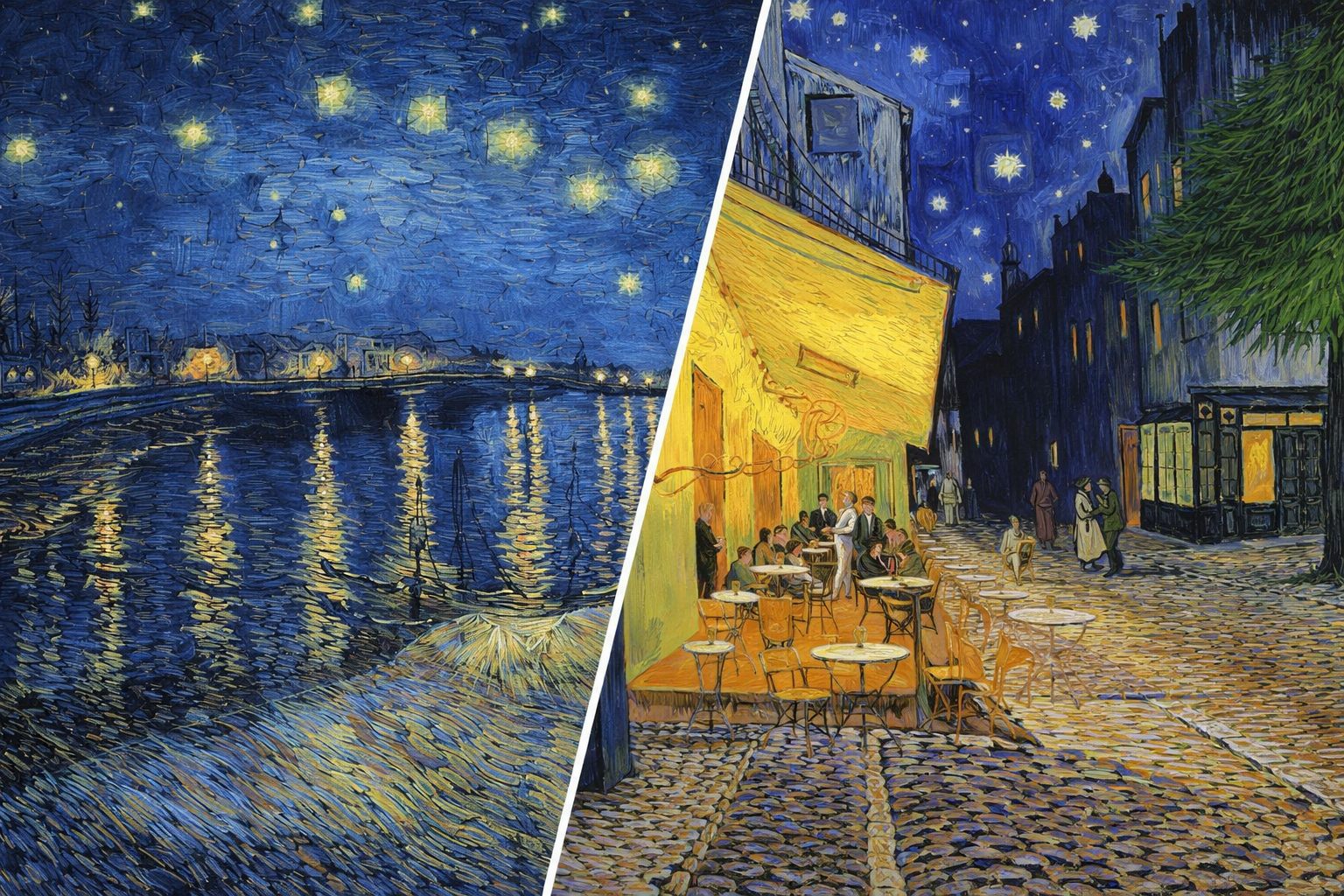
🌙 1. Starry Night Over the Rhône (1888)

Starry Night Over the Rhône
Painted in Arles in 1888, this was one of Van Gogh’s first major night scenes.
Unlike The Starry Night, this painting was created outdoors at night — something rare at the time. Van Gogh placed candles on his hat to see his canvas.
Key Features:
- Reflections of gas lamps on water
- Deep blue sky with golden stars
- A romantic couple walking by the river
- Calm atmosphere compared to the dramatic 1889 masterpiece
This painting feels peaceful and observational, while The Starry Night feels emotional and imagined.
🌌 2. Café Terrace at Night (1888)

Café Terrace at Night
Painted in Arles, this work captures a glowing café under a star-filled sky.
What makes it fascinating:
- It contains no black paint.
- The night sky is rendered in vibrant blues and greens.
- Artificial light becomes the central dramatic element.
Van Gogh transforms darkness into something luminous and inviting.
🌠 3. The Starry Night (1889)

Painted during his stay at the Saint-Rémy asylum, this is Van Gogh’s most famous nocturne.
Unlike the Arles night paintings, this one was created largely from imagination and memory. The swirling sky suggests emotion, spirituality, and psychological intensity.
It represents the peak of his nocturnal exploration.
🌌 What Makes Van Gogh’s Nocturnes Unique?
Van Gogh’s night paintings differ from traditional nocturnes in several ways:
1️⃣ Bold Color Instead of Darkness
Rather than using muted tones, he used saturated blues, yellows, and greens.
2️⃣ Emotional Expression
The sky often reflects inner turmoil or spiritual contemplation.
3️⃣ Artificial Light as Drama
Gas lamps, café lights, and stars become narrative elements.
🖌 Why Van Gogh Loved Painting at Night
Van Gogh believed night held more mystery and intensity than daylight.
In letters to his brother Theo, he described how night scenes allowed him to experiment with color contrast — particularly blue and yellow.
He was fascinated by:
- The glow of stars
- Reflections on water
- The psychological atmosphere of darkness
Night gave him creative freedom.
🌙 Comparison of the Three Major Night Paintings
| Painting | Year | Mood | Painted From |
|---|---|---|---|
| Starry Night Over the Rhône | 1888 | Calm & romantic | Direct observation |
| Café Terrace at Night | 1888 | Warm & luminous | Direct observation |
| The Starry Night | 1889 | Emotional & dramatic | Memory & imagination |
Together, they show his artistic evolution within just one year.
🎨 The Legacy of Van Gogh’s Nocturnes
Van Gogh’s night paintings influenced modern art by demonstrating that darkness could be vibrant and expressive.
Instead of portraying night as shadowy or muted, he showed that:
Night could glow.
Night could move.
Night could feel alive.
His nocturnes remain among the most reproduced and admired paintings in the world.
挺不错的样子嘛!