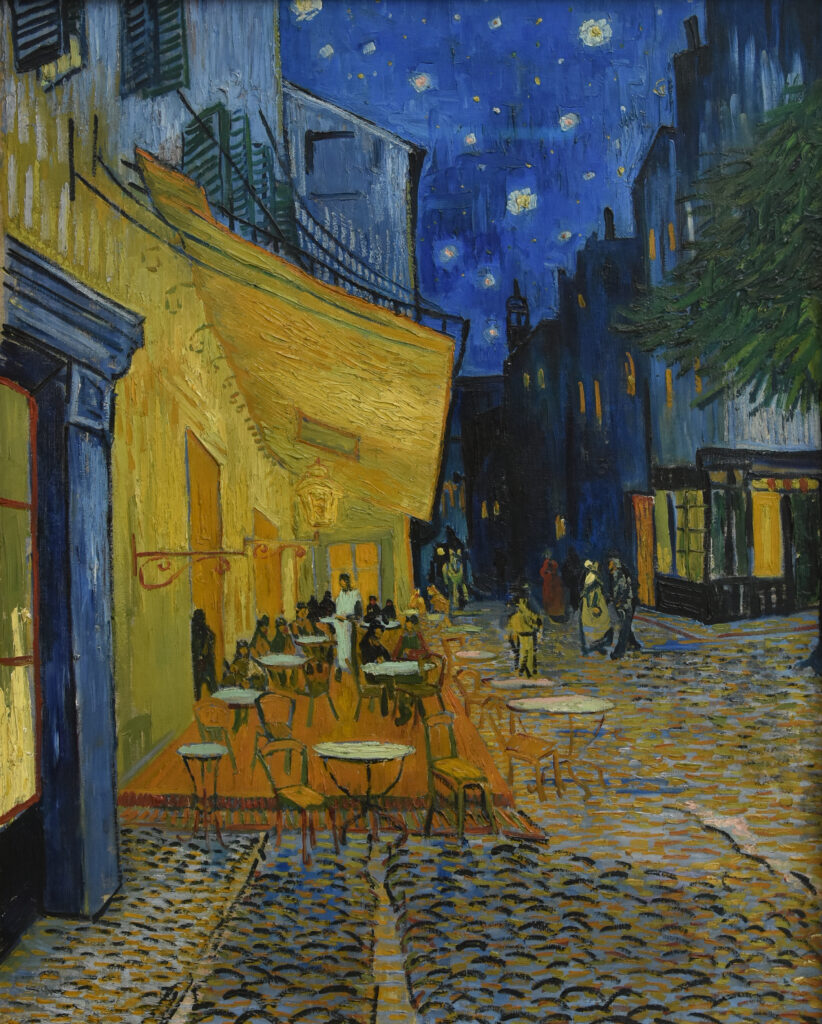
Café Terrace at Night is one of the most famous paintings created by Vincent van Gogh during his stay in Arles, France. Painted in 1888, the artwork depicts a lively café illuminated by warm yellow light under a deep blue night sky.
The painting is notable for its vibrant colors, dramatic perspective, and unique depiction of nighttime without using black paint. Today, it is considered one of Van Gogh’s most celebrated works and an important step in the development of his distinctive style.
In this article, we explore the story behind Café Terrace at Night, its artistic techniques, and its significance in Van Gogh’s career.
When Did Van Gogh Paint Café Terrace at Night?
Van Gogh painted Café Terrace at Night in September 1888 while living in the town of Arles in southern France.
At the time, he was exploring the idea of painting scenes at night. Rather than working from imagination in a studio, Van Gogh set up his easel outdoors and painted the scene directly under the night sky.
This approach allowed him to capture the atmosphere of the evening, including the glow of the café lights and the deep colors of the night.
The Scene Depicted in the Painting
The painting shows an outdoor café located on a street corner in Arles. The café terrace is brightly lit with warm yellow light, while the surrounding buildings and sky are painted in deep shades of blue.
Several people sit at tables outside the café, enjoying the evening. The street stretches into the distance, creating a strong sense of depth and perspective.
Above the scene, a star-filled sky spreads across the painting, hinting at Van Gogh’s growing fascination with nighttime landscapes.
Van Gogh’s Unique Use of Color
One of the most remarkable aspects of Café Terrace at Night is Van Gogh’s use of color.
Instead of using black to represent the night sky, he used deep blues and violets. The bright yellow of the café contrasts strongly with the cool tones of the surrounding environment.
This contrast creates a vibrant and dramatic effect that draws the viewer’s attention to the illuminated terrace.
Van Gogh believed that color could express emotion and atmosphere more powerfully than strict realism.
A New Way of Painting Night Scenes
Van Gogh was particularly interested in exploring how to paint nighttime scenes.
In a letter to his sister, he described how he wanted to paint the night without relying on black paint. Instead, he used combinations of blue, purple, and green to represent the darkness.
This innovative approach allowed him to create a night scene that feels lively and full of color rather than dark and dull.
Café Terrace at Night is one of the earliest examples of this technique.
The Location of the Café
The café depicted in the painting still exists today in Arles, France.
Originally called the Café de la Gare, it is now commonly referred to as Café Van Gogh. The building has been restored and painted in bright yellow to resemble the appearance seen in the painting.
Visitors to Arles often visit the location to see the real-life setting that inspired Van Gogh’s work.
Learn more about Van Gogh’s lifein Arles, France.
Connection to Other Night Paintings
Café Terrace at Night was part of Van Gogh’s exploration of night scenes.
Soon after completing this painting, he created several other famous works featuring nighttime settings, including:
- The Starry Night Over the Rhône
- The Starry Night
These paintings demonstrate Van Gogh’s fascination with the night sky and his ability to transform ordinary scenes into extraordinary works of art.
Why Café Terrace at Night Is Important
Café Terrace at Night is considered an important painting in Van Gogh’s career for several reasons.
First, it demonstrates his growing confidence with color and composition. The bold contrasts and dramatic perspective show his evolving artistic style.
Second, the painting represents his experimentation with nighttime scenes, which would later lead to masterpieces like The Starry Night.
Finally, the painting captures the lively atmosphere of everyday life in Arles, reflecting Van Gogh’s interest in ordinary places and people.
Conclusion
Café Terrace at Night remains one of Vincent van Gogh’s most beloved paintings. Through bold color, dramatic lighting, and innovative technique, he transformed a simple street café into a vibrant and unforgettable work of art.
The painting not only captures the charm of an evening in Arles but also marks an important moment in Van Gogh’s artistic journey as he explored new ways of painting light, color, and atmosphere.
Today, Café Terrace at Night continues to inspire viewers and remains a highlight of Van Gogh’s remarkable body of work.
A: Van Gogh painted Café Terrace at Night in September 1888 in Arles, southern France. Unlike many artists who painted from imagination indoors, Van Gogh set up his easel directly on the street at night to capture the scene under the actual evening sky — an unusual and bold approach at the time.
A: Yes — the café depicted in the painting still exists in Arles, France. Originally called the Café de la Gare, it is now known as Café Van Gogh and has been restored and painted in bright yellow to resemble its appearance in the painting. It is one of the most visited locations by tourists tracing Van Gogh’s footsteps in Arles.
A: Van Gogh deliberately avoided using black to depict the night sky. In a letter to his sister, he described his desire to paint night scenes using color alone — deep blues, violets, and greens — rather than darkness. This innovative approach made the night feel alive and vibrant rather than flat and dull, and became a defining feature of his nighttime paintings.
A: The painting marks an important turning point in Van Gogh’s work as one of his first serious attempts at painting a night scene outdoors. It demonstrates his growing confidence with bold color contrasts and dramatic perspective, and directly paved the way for later masterpieces including Starry Night Over the Rhône and The Starry Night.
A: Café Terrace at Night is housed at the Kröller-Müller Museum in Otterlo, Netherlands — one of the largest Van Gogh collections in the world. The museum holds over 90 Van Gogh paintings and nearly 180 drawings.